



Table of Contents
ToggleFortnite didn’t just launch, it exploded into the gaming landscape and fundamentally reshaped how millions play, compete, and interact online. But the story of when Fortnite actually released is more complicated than most players realize. The game exists in multiple forms, across different platforms, and its initial release date is wildly different from the moment it became a global phenomenon.
If you’re trying to pinpoint exactly when Fortnite came out, you’re tracking multiple release dates. The original Save the World mode launched in 2017 as a co-op survival game. Just months later, Battle Royale arrived and turned the gaming industry upside down. Then came mobile versions, console expansions, and next-gen optimizations, each marking a new chapter in Fortnite’s evolution.
This timeline breaks down every major Fortnite release date, platform launch, and industry-shifting milestone. Whether you started building walls in 2017 or dropped into your first match in Chapter 3, here’s the definitive record of how Fortnite went from a seven-year development project to a cultural juggernaut.
Key Takeaways
- Fortnite released in two major forms: Save the World launched on July 25, 2017, while Battle Royale—the game-changing free-to-play version—released on September 26, 2017.
- Fortnite’s unique building mechanics, combined with its free-to-play model and accessibility across platforms, helped it rapidly surpass PUBG and become a global phenomenon with 30 million players by December 2017.
- The game expanded across mobile (iOS March 2018, Android August 2018), Nintendo Switch (June 2018), and next-gen consoles (PS5/Xbox Series X|S November 2020), with seamless cross-platform play that democratized access.
- Fortnite’s seasonal Chapter system and cosmetic monetization model revolutionized the free-to-play industry, generating $9 billion in revenue and inspiring competitors like Apex Legends and Call of Duty to adopt similar Battle Pass strategies.
- Beyond gaming, Fortnite became a cultural phenomenon hosting record-breaking virtual concerts (12.3 million concurrent viewers for Travis Scott) and mainstream crossovers with Marvel, Star Wars, and anime properties.
- Epic’s continuous map overhauls, new mechanics, and live-service evolution transformed a modest survival game into an ever-changing social platform that redefined how players engage with multiplayer experiences.
The Original Fortnite: Save the World Release
Early Development and Announcement
Epic Games first revealed Fortnite at the 2011 Spike Video Game Awards, announcing an ambitious co-op sandbox survival game. The initial vision centered around scavenging resources during the day and defending against zombie-like husks at night. Veteran designer Cliff Bleszinski led early development before departing Epic in 2012.
The game spent six years in development, an unusually long cycle that raised questions about whether it would ever ship. Epic tested various mechanics, art styles, and progression systems throughout this period. By 2014, the project had evolved into a free-to-play model with building mechanics as its core differentiator.
Closed alpha testing began in 2014, followed by invite-only periods that gave select players their first hands-on experience. Epic gradually expanded access through 2015 and 2016, refining the tower-defense shooter hybrid based on community feedback.
Official Launch Date and Initial Reception
Fortnite: Save the World officially released on July 25, 2017 as a paid early access title. Epic launched it simultaneously on PC, PlayStation 4, and Xbox One for $39.99, with higher-tier founder packs offering additional perks and in-game currency.
The initial reception was positive but modest. Critics praised the building mechanics and cartoon art style but noted repetitive mission design and aggressive monetization. Save the World attracted a dedicated niche audience, mostly players who enjoyed co-op looter-shooters and tower defense hybrids.
Sales were steady but unremarkable. In its first month, Save the World generated respectable revenue without breaking into mainstream consciousness. The game felt like a solid B-tier release destined for a dedicated but limited player base. Nobody predicted what would happen just two months later.
Fortnite Battle Royale: The Game-Changing Release
Battle Royale Release Date and Platform Availability
Fortnite Battle Royale launched on September 26, 2017, completely free-to-play on PC, PS4, and Xbox One. Epic Games dropped it with minimal marketing fanfare, just a quick announcement and immediate availability.
The mode supported 100 players per match, featured the same building mechanics from Save the World, and ran on the same cartoonish aesthetic. Maps started with a single location called the Battle Royale Island (later known as the Chapter 1 map), and matches followed the standard shrinking storm circle format.
Within two weeks, Battle Royale hit 10 million players. By December 2017, that number jumped to 30 million. The growth curve was unprecedented, even Epic seemed caught off guard by the explosive demand.
Why Epic Games Pivoted to Battle Royale
Epic’s decision to create Battle Royale wasn’t purely strategic genius, it was opportunistic adaptation. PlayerUnknown’s Battlegrounds (PUBG) had exploded in popularity throughout 2017, proving the battle royale genre’s mainstream appeal. Epic recognized they already had the tools to compete: robust building mechanics, a polished engine, and art assets from Save the World.
Development took just two months. A small team prototyped the mode internally, adapting Save the World’s systems for PvP competition. The building mechanics, originally designed for defensive fortifications against AI enemies, became the defining skill gap in player-versus-player combat.
Epic made Battle Royale completely free and separate from Save the World, removing all barriers to entry. This decision proved critical. While PUBG required a $30 purchase and ran poorly on many systems, Fortnite was free, accessible, and ran smoothly across hardware configurations. The battle royale market had room for multiple games, and as major industry publications noted at the time, Fortnite’s unique building mechanics gave it clear differentiation from PUBG’s military sim approach.
Mobile Release: Bringing Fortnite to iOS and Android
iOS Launch and Cross-Platform Innovation
Fortnite hit iOS devices on March 15, 2018, starting with an invite-only beta before opening to all players in early April. This wasn’t a stripped-down mobile port, Epic delivered the full Battle Royale experience with cross-platform play against console and PC players.
The technical achievement was remarkable. Fortnite ran at 30 FPS on iPhone 6S and newer models, with higher frame rates on iPad Pro devices. Touch controls included customizable HUD layouts, aim assist, and dedicated building buttons. Epic even implemented gyroscope aiming for players who preferred motion controls.
Cross-platform parties meant mobile players could squad up with friends on any platform. This broke down traditional gaming barriers and expanded Fortnite’s reach exponentially. Kids without consoles or gaming PCs could now play the same game as everyone else, using devices they already owned.
iOS revenue exploded immediately. Within its first month, Fortnite Mobile generated over $25 million in player spending, entirely from cosmetic purchases. Epic had cracked the code: premium Battle Pass content and cosmetic rewards that didn’t compromise competitive balance.
Android Release and Distribution Challenges
Fortnite arrived on Android on August 9, 2018, but with a controversial twist. Epic bypassed the Google Play Store entirely, distributing the game directly through their website and the Samsung Galaxy Store. This avoided Google’s 30% revenue cut but created friction for average users unfamiliar with sideloading apps.
The Samsung exclusivity period lasted from August through mid-October 2018, giving Galaxy device owners early access. Players downloaded the Fortnite Installer APK directly from Epic’s site, then used it to install and update the game. Security warnings during installation scared off some users, though millions downloaded it anyway.
Epic finally added Fortnite to the Google Play Store on April 21, 2020, after nearly two years of direct distribution. They publicly criticized Google’s 30% fee while simultaneously listing the game on the platform, setting the stage for their later legal battle over app store policies.
Android’s technical landscape proved messier than iOS. The massive variety of hardware configurations meant performance varied wildly. High-end devices like the Samsung Galaxy S9 and OnePlus 6 ran smoothly, while budget phones struggled with frame drops and heating issues.
Platform Expansion: Console and Next-Gen Releases
Nintendo Switch Debut
Fortnite surprised the gaming world by shadow-dropping on Nintendo Switch during the June 12, 2018 Nintendo Direct presentation. Epic announced and released it the same day, no pre-release marketing, no beta period, just immediate availability.
The Switch version included full cross-platform support, meaning handheld players competed in the same lobbies as everyone else. Performance targeted 30 FPS with dynamic resolution scaling, typically hovering around 720p in handheld mode and 1000p when docked.
Nintendo’s younger demographic embraced Fortnite instantly. The combination of portable play and full cross-progression meant kids could grind Battle Pass challenges on the bus, then switch to PS4 or PC at home without losing progress. Switch became one of Fortnite’s most popular platforms even though technical limitations.
PlayStation 5 and Xbox Series X/S Optimization
Fortnite received next-gen optimization alongside the PS5 and Xbox Series X/S console launches in November 2020. Epic didn’t just boost resolution and frame rates, they implemented features that showcased the new hardware’s capabilities.
Next-gen versions introduced:
- 120 FPS mode in Battle Royale (performance mode)
- 4K resolution at 60 FPS (quality mode)
- Dynamic visuals with improved shadows, draw distance, and effects
- Faster loading times thanks to SSD integration (sub-15-second lobby-to-match loads)
- Split-screen improvements with better performance than last-gen consoles
The PS5 version leveraged haptic feedback and adaptive triggers on the DualSense controller. Different weapons produced unique trigger resistance, shotguns had heavier pulls, SMGs offered rapid light taps. Harvesting materials and taking storm damage created distinct haptic patterns.
Epic delivered these next-gen versions as free upgrades for existing players. Anyone who owned Fortnite (which was everyone, since it’s free) automatically received the enhanced version when logging in on new hardware. Cross-platform matchmaking remained seamless, with next-gen players mixed into lobbies based on input method rather than hardware.
Major Milestones in Fortnite’s Post-Launch Journey
Chapter System and Seasonal Evolution
Epic introduced Seasons with Battle Royale’s launch, but the format evolved dramatically. Early seasons lasted 10-12 weeks and introduced incremental map changes, new weapons, and themed Battle Pass cosmetics. Season 1 was barebones, just 70 tiers of rewards and basic challenges.
Season 3 (February 2018) established the Battle Pass formula that defined Fortnite: 100 tiers, weekly challenges, progressive skins, and thematic storytelling. The season introduced the meteor storyline that would culminate in Dusty Depot’s destruction.
Chapter 2 launched on October 15, 2019, after a shocking 36-hour blackout event where Fortnite was completely unplayable. The original map was destroyed and replaced with an entirely new island. Epic reset the season numbering, starting fresh with Chapter 2, Season 1.
Chapter 3 arrived on December 5, 2021, flipping the island upside down and introducing web-slinging mechanics. Chapter 4 followed on December 4, 2022, and the current Chapter 5 launched on December 3, 2023. Each chapter brings radical map overhauls, new movement mechanics, and fresh meta shifts that keep the seasonal content calendar unpredictable.
Cross-Platform Play and Account Merging
Full cross-platform parties became standard in September 2018, though the feature rolled out gradually. PlayStation initially resisted, creating the infamous “locked account” controversy where PS4 players couldn’t use their Epic accounts on Switch or Xbox.
Sony finally enabled full cross-play in September 2018 following community pressure. Epic introduced input-based matchmaking shortly after, controller players faced primarily controller lobbies, while keyboard-mouse users matched with other PC players. The system wasn’t perfect (players debated whether it truly separated inputs), but it addressed competitive balance concerns.
Account merging launched in November 2018, allowing players who created separate accounts across platforms to consolidate cosmetics, V-Bucks, and progression. The feature existed until May 2019, giving players a limited window to merge duplicate accounts before Epic disabled it permanently.
Competitive Scene and Fortnite World Cup
Epic announced competitive Fortnite in May 2018 with early tournament experiments. The first Summer Skirmish series ran throughout July-September 2018, featuring invited pro players and streamers competing for prize pools.
Arena Mode launched in Season 8 (February 2019), introducing ranked matchmaking with persistent point-based progression. Players climbed through divisions (Open, Contender, Champion) by earning hype points through placement and eliminations.
The Fortnite World Cup took place July 26-28, 2019 at Arthur Ashe Stadium in New York. The event featured a $30 million prize pool, the largest in esports history at the time. Kyle “Bugha” Giersdorf won the Solo competition, taking home $3 million at age 16.
Qualification was purely merit-based through online tournaments. Any player who reached Champion division could compete in weekly qualifiers, with top performers earning World Cup spots. This open format, no org-controlled invites, democratized competitive access in ways traditional esports hadn’t.
Epic hasn’t hosted another in-person World Cup since 2019, pivoting to online Fortnite Champion Series (FNCS) seasons with regional competitions. FNCS runs multiple times per year with million-dollar prize pools, maintaining competitive infrastructure even without massive live events.
How Fortnite’s Release Changed the Gaming Industry
The Free-to-Play Model Revolution
Fortnite proved that premium free-to-play could eclipse traditional $60 releases in revenue and cultural impact. Epic generated $9 billion in revenue during Fortnite’s first two years (2018-2019), almost entirely from cosmetic microtransactions.
The Battle Pass model, $9.50 for 75+ cosmetic items across a season, became the industry template. Players who completed the pass earned enough V-Bucks to buy the next one, creating a retention loop where engaged players essentially subscribed for free. Casual spenders got tremendous value while whales bought additional tiers and Item Shop bundles.
Competitors rapidly copied the formula. Apex Legends (2019), Call of Duty: Warzone (2020), and Halo Infinite (2021) all adopted Fortnite’s seasonal Battle Pass structure. Even premium franchises like Call of Duty transitioned to free-to-play battle royale modes with cosmetic monetization.
Fortnite normalized expensive cosmetics in ways previous games hadn’t. Legendary skins at 2,000 V-Bucks ($20) sold millions of units. Crossover skins featuring Marvel heroes, anime characters, and musicians commanded premium prices without affecting gameplay balance. The Item Shop rotation created artificial scarcity that drove impulse purchases.
Cultural Impact and Mainstream Recognition
Fortnite transcended gaming to become a cultural phenomenon by late 2018. NFL players performed Fortnite emotes as touchdown celebrations. Antoine Griezmann did the Take the L dance after scoring in the 2018 World Cup Final. Schools sent letters home warning parents about Fortnite addiction.
The game hosted virtual concerts that redefined what multiplayer experiences could be. Marshmello’s February 2019 concert drew 10.7 million concurrent players. Travis Scott’s Astronomical event in April 2020 attracted 12.3 million concurrent viewers across five showtimes, with players experiencing a psychedelic journey through a transforming map.
Crossover collaborations brought unprecedented IP integration. Marvel took over entire seasons with Avengers-themed content. Star Wars premiered a movie clip exclusively in Fortnite. Dragon Ball, Naruto, and anime crossovers introduced Eastern pop culture to Western players.
As industry analysts documented, Fortnite became the social platform where Gen Z hung out. For millions of kids and teens, Fortnite lobbies replaced phone calls and text chains. The game’s cultural footprint extended far beyond its player count, even non-gamers recognized default dances and knew what “Victory Royale” meant.
Epic leveraged this reach to build the Epic Games Store, using Fortnite’s massive PC install base to challenge Steam’s dominance. They poached exclusives and offered free games weekly, funded largely by Fortnite’s revenue. The strategy reshaped PC gaming distribution even though ongoing controversy over platform fragmentation.
Fortnite Release Timeline: Quick Reference Guide
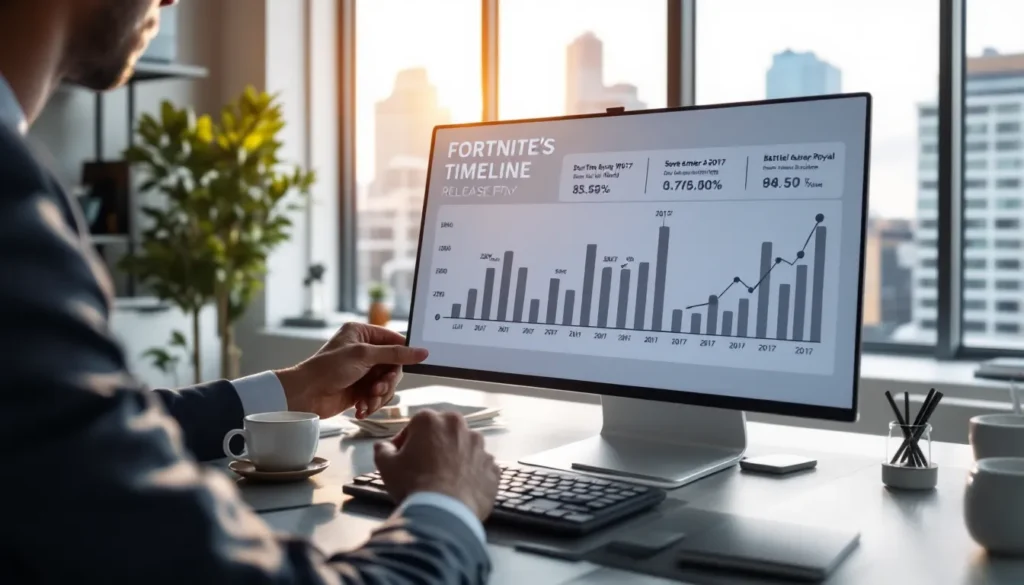
Here’s every major Fortnite release date in chronological order:
2017
- July 25: Save the World early access (PC, PS4, Xbox One)
- September 26: Battle Royale free release (PC, PS4, Xbox One)
2018
- March 15: iOS beta launch (invite-only initially)
- June 12: Nintendo Switch release (same-day announcement and launch)
- August 9: Android release (Epic direct download, Samsung exclusivity)
- September 2018: Full cross-platform play enabled (PlayStation finally joins)
2019
- July 26-28: Fortnite World Cup (New York)
- October 15: Chapter 2 launch (complete map replacement)
2020
- April 21: Google Play Store release (after 20 months of direct distribution)
- November: PS5 and Xbox Series X/S optimized versions (launch day)
2021
- December 5: Chapter 3 launch
2022
- December 4: Chapter 4 launch
2023
- December 3: Chapter 5 launch
Note: Epic never fully released Save the World from early access. In June 2020, they announced it would remain in early access indefinitely and stopped selling founder packs, effectively ending development on the original game mode. Battle Royale became “Fortnite” in the public consciousness, with most players unaware Save the World even exists.
The game remains available on PC (Epic Games Store), PlayStation 4/5, **Xbox One/Series X
|
S**, Nintendo Switch, and mobile (though iOS availability ended in August 2020 due to Epic’s legal battle with Apple: players can still access it through cloud gaming services like Xbox Cloud Gaming and GeForce Now).
Whether you’re tracking down specific weapon data or trying to remember when a particular feature launched, this timeline covers the major beats. Fortnite’s release story isn’t a single date, it’s an ongoing evolution across platforms, modes, and player experiences.
Conclusion
Fortnite’s release dates tell the story of a game that kept evolving, adapting, and expanding in ways few titles ever achieve. What started as a niche co-op survival game in July 2017 transformed into a free-to-play battle royale juggernaut by September of that same year. From there, Epic kept pushing, mobile launches that brought console-quality gameplay to phones, next-gen optimizations that showcased new hardware, and cultural events that turned a shooter into a social platform.
The answer to “when did Fortnite release” depends entirely on which Fortnite you mean. Save the World arrived first but faded into obscurity. Battle Royale launched two months later and changed gaming forever. Mobile versions democratized access. Chapter transitions reset expectations and kept veterans engaged.
What matters most isn’t any single date, it’s the pattern. Epic proved that live-service games could remain relevant through constant reinvention, that free-to-play didn’t mean cheap or predatory, and that gaming experiences could transcend entertainment to become cultural touchstones. Whether you’re a Chapter 1 veteran or someone who just started in Chapter 5, you’re part of that evolution. The game that Epic launched on September 26, 2017 barely resembles what Fortnite has become, and that’s precisely why it’s still here.