

Table of Contents
ToggleThe Fortnite x Marshmello event wasn’t just another in-game crossover, it redefined what’s possible in live digital entertainment. On February 2, 2019, over 10.7 million players dropped into Pleasant Park to experience the first-ever large-scale virtual concert inside a battle royale game. Marshmello’s in-game performance turned the island into a pulsating, gravity-defying spectacle, complete with custom music tracks, synchronized visuals, and gameplay mechanics that temporarily transformed Fortnite into something closer to a shared music festival than a competitive shooter.
Since that landmark event, Marshmello’s cosmetics have remained some of the most sought-after items in the Item Shop. Whether you missed the original concert or you’re hunting down the elusive Toasted Marshmello style in 2026, this guide covers everything: the history of the collaboration, every cosmetic item tied to the DJ, how to grab them today, and why this event still matters in gaming culture seven years later.
Key Takeaways
- The historic Fortnite x Marshmello event on February 2, 2019, set a new standard for in-game concerts by attracting 10.7 million concurrent players and proving games could function as legitimate entertainment venues.
- Marshmello’s white helmet aesthetic and accessible electronic music made him the perfect fit for Fortnite’s colorful world, helping establish a blueprint that led to future major collaborations with artists like Travis Scott and Ariana Grande.
- The Toasted Marshmello style remains permanently exclusive to players who attended the original 2019 Showtime event, making it one of the rarest cosmetics in Fortnite’s Item Shop and a true badge of gaming history.
- The full Marshmello cosmetics set, including the outfit, pickaxe, and emotes, typically costs around 2,500 V-Bucks ($20-25 USD) and periodically rotates back to the Item Shop during February anniversaries and Festival Mode updates.
- Marshmello’s concert introduced gameplay mechanics never before attempted at that scale—gravity shifts, synchronized emotes, and environmental transformations—that fundamentally changed how developers approach virtual live events in gaming.
Who Is Marshmello and Why Did Fortnite Choose Him?
Marshmello is the stage persona of American electronic music producer and DJ Christopher Comstock, known for wearing a signature white helmet resembling a cartoon marshmallow. By 2019, he’d already racked up billions of streams with hits like “Alone,” “Happier” (with Bastille), and “Silence” (with Khalid). His brand was built on accessibility, upbeat, melodic electronic music that appealed to mainstream audiences, not just EDM diehards.
Fortnite’s choice wasn’t random. Epic Games needed an artist whose aesthetic matched the game’s colorful, whimsical art style and whose music had broad cross-generational appeal. Marshmello’s helmet and playful branding fit seamlessly into Fortnite’s cartoonish world, and his fanbase overlapped heavily with Fortnite’s player demographics: teens, young adults, and even younger kids whose parents recognized the name.
The collaboration was also a test case. Epic wanted to prove that Fortnite could function as a legitimate platform for live entertainment, not just a place to shoot and build. Marshmello’s existing relationship with gaming culture, he’d already livestreamed Fortnite sessions on his own channel, made him a natural partner for what would become one of the most ambitious experiments in gaming history.
From a business perspective, the partnership was mutually beneficial. Marshmello gained exposure to Fortnite’s massive player base, while Epic demonstrated to other artists and brands that the game could deliver unprecedented reach for virtual events. The fact that it worked so well paved the way for Travis Scott, Ariana Grande, and countless other collaborations that followed.
The Historic Marshmello Concert Event in Fortnite
How the Concert Worked: Gameplay Mechanics and Experience
The Marshmello concert took place on February 2, 2019, at 2:00 PM ET in a special Limited Time Mode called Showtime. Players queued into the mode just like any other match, but instead of weapons and storm circles, they spawned into Pleasant Park with all combat disabled. No shooting, no building, no eliminations, just 10.7 million people standing together in a shared space.
Once the concert began, the gameplay mechanics bent in ways that felt borderline surreal. Marshmello’s avatar materialized on a massive virtual stage at Pleasant Park, and the island itself transformed. Players experienced:
- Gravity shifts that launched everyone into the air during bass drops
- Environmental effects that turned the sky into kaleidoscopic patterns
- Synchronized emotes that auto-triggered, making every player dance in unison
- Interactive objects like giant floating marshmallows and color-shifting terrain
The setlist included ten tracks, mostly Marshmello originals plus a few remixes, that played over roughly ten minutes. The audio was client-side synchronized, meaning every player heard the exact same mix at the exact same moment, regardless of platform or server location. Epic’s engineers had to solve significant technical challenges to pull this off without desyncs or audio glitches across millions of concurrent players.
One of the smartest design choices was making the event respawnable. If you got disconnected or joined late, you could queue back in and still catch most of the show. Epic ran multiple showings to accommodate global time zones, ensuring players from Europe to Asia could attend without staying up until 3 AM.
Record-Breaking Attendance and Cultural Impact
The numbers were staggering. Epic Games confirmed that 10.7 million concurrent players attended the live event, with millions more watching via Twitch and YouTube streams. At the time, it shattered records for the largest live virtual event in history, not just in gaming, but across all digital platforms.
The cultural ripple effects were immediate. Gaming news outlets covered the event as a watershed moment, and mainstream media like The New York Times and BBC ran features exploring what it meant for the future of entertainment. Suddenly, Fortnite wasn’t just a game, it was a venue, a platform, a digital public square where millions could gather for shared experiences.
For players who attended, the concert became a defining memory. The community still references it in forums and social media, often with nostalgia for a time when Fortnite felt more experimental and less focused on competitive balance or monetization. The event proved that games could host moments of genuine collective joy, not just competition or grinding.
It also set a template that other games scrambled to copy. Within months, competitors like Roblox and Minecraft started hosting their own virtual concerts, though none matched the production value or attendance of Marshmello’s show until Travis Scott’s Astronomical event in April 2020.
All Marshmello Skins and Cosmetics in Fortnite
Marshmello Outfit and Variants
The Marshmello outfit debuted in the Item Shop on February 1, 2019, one day before the concert. It’s an Icon Series skin, which means it’s tied directly to a real-world celebrity or brand rather than being an original Fortnite creation.
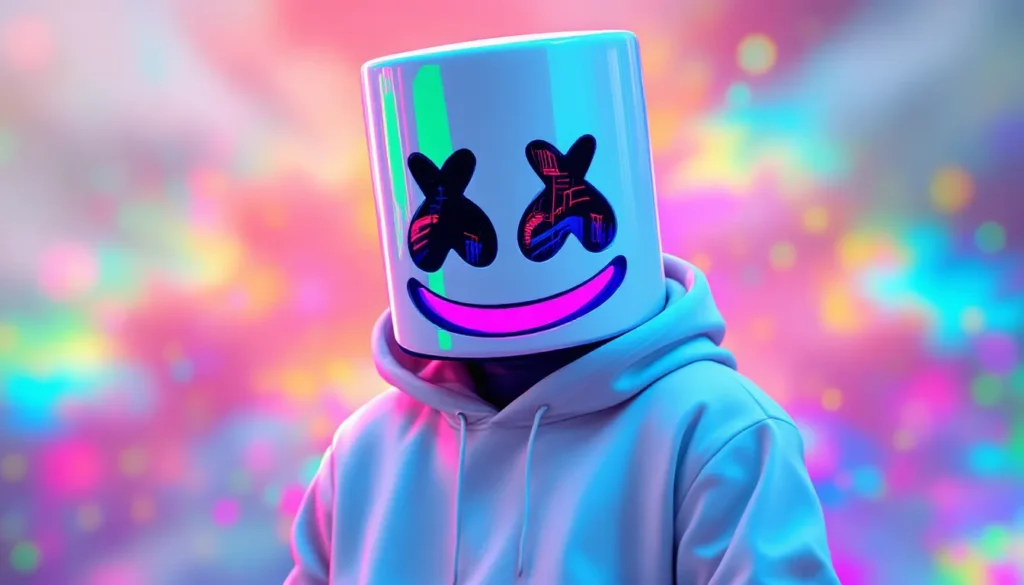
The default style is a perfect recreation of Marshmello’s signature look: white helmet with X-shaped eyes and a smiling mouth, white hoodie, black pants, and sneakers. The skin is surprisingly clean and minimalist compared to the increasingly elaborate cosmetics Fortnite has released in recent years, which actually makes it more versatile for mix-and-match combos.
What sets the Marshmello outfit apart is its reactive features. The helmet’s eyes and mouth glow and pulse in sync with certain emotes, particularly the Marsh Walk built-in emote (more on that below). It’s a subtle touch, but it makes the skin feel more alive and connected to the music theme.
Toasted Marshmello Style and How to Unlock It
The Toasted Marshmello style is a variant that turns the pristine white helmet into a charred, burnt brown version, like a marshmallow that spent too long over a campfire. It’s easily the rarest and most coveted variant tied to the collaboration.
Originally, players unlocked Toasted Marshmello by completing a set of challenges during the Showtime event. The challenges were simple: attend the concert and complete a few additional objectives tied to dancing and exploring. If you missed the event window, you missed the style, permanently. Epic has never re-released the Toasted variant, and there’s no indication they plan to in 2026.
This makes Toasted Marshmello a true legacy item, visible proof that you were there for one of Fortnite’s most iconic moments. Players who rock the burnt style in lobbies today are flexing not just a cosmetic, but a piece of gaming history.
Complete List of Marshmello Back Bling, Pickaxes, and Emotes
The Marshmello set includes several cosmetics beyond the skin itself:
Back Bling:
- Marshmello’s Pack – A white backpack with Marshmello’s logo and reactive LED lights that pulse with the helmet. It’s bundled with the Marshmello outfit and isn’t sold separately.
Pickaxes:
- Marshmellon – A dual-wielding pickaxe shaped like white, glowing drumsticks. The tips light up with each swing, and the sound effects are modified to sound like drum hits. It’s sold separately from the skin and typically costs 800 V-Bucks.
Emotes:
- Marsh Walk – Marshmello’s signature built-in emote. When activated, the skin dances with a bouncy, shuffling gait while the helmet lights up and pulses. Traversal emote, so you can move while dancing.
- Flux – A blue-rarity emote inspired by Marshmello’s aesthetic. Players perform a quick dance move while glowing energy pulses around them. Costs 500 V-Bucks.
Gliders and Wraps:
While there’s no official Marshmello glider, players often pair the skin with white or neon-themed gliders from other sets. The Marshmello wrap wasn’t part of the original launch but has been requested by the community for years, still no sign of it as of Chapter 5.
The entire bundle, skin, back bling, pickaxe, and emotes, can set you back around 3,000 V-Bucks if purchased individually, though Epic has occasionally offered limited-time bundles at slight discounts.
How to Get Marshmello Items in 2026
Item Shop Rotation and Availability
As of March 2026, the Marshmello skin and cosmetics are classified as Icon Series items, which means they return to the Item Shop periodically but don’t follow a predictable schedule. Epic tends to bring back music-related skins during events tied to concerts, festivals, or music updates, so your best bet is to watch for:
- Festival Mode updates – Fortnite’s rhythm game mode, introduced in Chapter 5, frequently rotates music-themed cosmetics when new tracks or artists are added.
- Anniversary events – February 2nd often sees Marshmello items return to celebrate the original concert’s anniversary, though Epic doesn’t guarantee this every year.
- Random Icon Series rotations – Icon skins rotate in and out without warning, so check the shop daily if you’re hunting specific items.
The Toasted Marshmello style remains locked to players who unlocked it during the original Showtime event. There’s no way to earn it in 2026 unless Epic decides to re-release it as part of a legacy event, which seems unlikely given their pattern of keeping event-exclusive rewards exclusive.
One workaround: keep an eye on community discussions and guides where players speculate about upcoming Item Shop rotations based on datamines and Epic’s event calendar.
Expected Price Points for Marshmello Cosmetics
Pricing for Marshmello items has remained consistent since 2019:
- Marshmello Outfit (includes Marshmello’s Pack back bling): 1,500 V-Bucks
- Marshmellon Pickaxe: 800 V-Bucks
- Marsh Walk Emote (built-in, free with skin): Included
- Flux Emote: 500 V-Bucks
If Epic offers a bundle, which they occasionally do during major rotations, expect to pay around 2,500 V-Bucks for the full set, saving you about 700 V-Bucks compared to buying everything separately.
To put that in real-world money: 1,000 V-Bucks costs roughly $7.99 USD, so the full Marshmello set runs about $20-25 depending on whether you catch a bundle deal. Compared to newer Icon Series skins, Marshmello is mid-tier pricing, cheaper than Ariana Grande’s bundle but more expensive than basic emote-only collabs.
The Marshmello Creative Map and Challenges
Plus to the live concert, Epic released a Marshmello Creative Map (Island Code: 9387-4659-6799) that let players explore a custom-built venue themed around the DJ’s aesthetic. The map featured interactive DJ booths, dance floors with reactive lighting, and hidden collectibles scattered throughout.
The map was designed as both a social hangout space and a challenge gauntlet. Players could complete objectives like:
- Finding hidden Marshmello helmets across the island
- Dancing on specific platforms to unlock rewards
- Playing mini-games like rhythm challenges and parkour courses
These challenges were tied to the Showtime event and rewarded players with bonus XP, sprays, and the Toasted Marshmello style. Once the event ended, the map remained accessible in Creative mode, but the challenges and rewards were disabled.
As of 2026, the original map code still works, and players can load it for nostalgia or private party sessions. But, the map hasn’t been updated since 2019, so it lacks newer Creative features like Verse scripting or UEFN tools. Some community creators have built spiritual successors, updated concert venues and music-themed maps inspired by the original, but none carry the official Marshmello branding.
The Creative Map was an underrated part of the collaboration. While the live concert grabbed headlines, the persistent map gave fans a space to keep engaging with the Marshmello theme long after the show ended. It also demonstrated how virtual events could extend beyond a single moment, offering ongoing value through Creative tools.
How Marshmello’s Event Changed Gaming Culture Forever
Impact on Future In-Game Concerts and Virtual Events
The Marshmello concert proved that games could function as legitimate venues for live entertainment, not just interactive software. Before February 2019, most “in-game events” were limited to cutscenes, boss fights, or map changes. Marshmello’s show introduced the concept of passive, shared experiences inside a competitive game, a radical departure from Fortnite’s core loop.
The event’s success directly influenced Epic’s strategy for the next several years. Within 18 months, Fortnite hosted Travis Scott’s Astronomical (12.3 million concurrent viewers), followed by concerts from Ariana Grande, J Balvin, and dozens of smaller Festival Mode performances. Other games scrambled to catch up: Roblox hosted Lil Nas X, PUBG Mobile partnered with Blackpink, and even Minecraft explored live music events.
Beyond gaming, the Marshmello concert accelerated conversations about the metaverse, persistent digital spaces where people gather for social, cultural, and economic activity. While the term became overused and corporate by 2023, the core idea traces back to moments like this: millions of people experiencing something meaningful together in a virtual world.
The event also validated gaming as a mainstream entertainment platform. Major outlets covered the show as a cultural milestone, not just a gimmick, and brands took notice. Suddenly, marketing teams at Fortune 500 companies were asking, “How do we get into Fortnite?” The flood of brand collabs, from Marvel to Star Wars to NFL, can be traced, at least in part, to the blueprint Marshmello helped establish.
Comparison to Other Fortnite Music Events
How does the Marshmello concert stack up against the music events that followed?
Marshmello (February 2019):
- Attendance: 10.7 million concurrent
- Style: Single-stage concert with synchronized emotes and environmental effects
- Innovation: First large-scale virtual concert in a battle royale game
Travis Scott – Astronomical (April 2020):
- Attendance: 12.3 million concurrent (27.7 million total across five showings)
- Style: Multi-stage, surreal journey through different environments (underwater, space, giant Travis)
- Innovation: Pushed technical and artistic boundaries far beyond Marshmello’s blueprint. Players flew through space and experienced perspective shifts that felt closer to an interactive music video than a concert.
Ariana Grande – Rift Tour (August 2021):
- Attendance: Not officially disclosed, estimated 10+ million
- Style: Interdimensional tour with color-shifting environments, alien landscapes, and player transformations
- Innovation: Incorporated narrative elements and gameplay mechanics that made it feel like a mini-campaign rather than a static show.
By sheer production value, Travis Scott’s Astronomical is often considered the peak of Fortnite’s concert ambitions. But Marshmello holds a special place because it was first. It lacked the scale and spectacle of later events, but it introduced the format and proved the concept. Travis Scott and Ariana Grande could experiment because Marshmello had already shown that millions of players would actually show up.
In terms of cultural legacy, Marshmello’s concert remains the most historically significant, not because it was the best, but because it changed what everyone thought was possible.
Tips for Experiencing and Enjoying Future Fortnite Events
If you missed Marshmello, or any of the big in-game events since, here’s how to make sure you’re ready for the next one.
Check Epic’s Social Channels Early:
Epic typically announces major events 1-2 weeks in advance via Twitter, Instagram, and the in-game newsfeed. Don’t rely solely on third-party sites: follow @FortniteGame directly for official timing and details.
Queue In Early:
Limited Time Modes for big events go live 30-60 minutes before showtime. Get into the lobby early to avoid last-minute server congestion. During Marshmello and Travis Scott, players who queued at the last second often got stuck in matchmaking or missed the start.
Turn Off Competitive Settings:
If you have performance mode or low settings enabled for competitive play, switch to higher graphics for events. These experiences are designed to be visually stunning, and you’ll miss half the spectacle with effects turned off.
Disable Voice Chat (or Party Up with Friends):
In-game voice chat during events can be chaotic. If you want to focus on the show, mute randoms or create a private party with friends so you can actually hear the audio.
Record or Screenshot Memorable Moments:
Fortnite’s Replay Mode works during events, but it’s not always reliable for capturing every detail. Use your platform’s native recording tools (Xbox Game Bar, PS5 Share, Nvidia ShadowPlay) to save clips in real-time.
Check Multiple Showings:
Epic often schedules multiple showings of major events to accommodate global time zones. If the first showing has technical issues or you miss it, you usually have another chance within a few hours.
Don’t Expect Combat:
Weapons and building are disabled during music events and major story moments. If you queue in expecting a normal match, you’ll be confused when nothing works.
Explore Afterward:
Sometimes Epic leaves environmental changes or interactive objects on the map after events conclude. Hop into a regular match right after and check if anything’s different, players have found hidden teasers and map changes this way.
Most importantly: just show up. Fortnite’s live events are some of the only truly ephemeral experiences in modern gaming. They happen once, and then they’re gone. Sure, you can watch VODs on YouTube later, but being there, sharing the moment with millions of other players in real-time, is what makes them special.
Conclusion
The Fortnite x Marshmello collaboration didn’t just introduce a skin or a concert, it introduced a new category of digital experience. Seven years later, the event still stands as a defining moment in gaming culture, proof that games can host genuine cultural events that rival anything in the physical world.
If you’re hunting down the Marshmello cosmetics in 2026, keep an eye on the Item Shop rotations around February and during Festival Mode updates. The default skin and pickaxe remain available, but the Toasted Marshmello style is forever locked to those who attended the original Showtime event, a badge of honor for players who were there when gaming history was made.
Whether you’re a collector chasing Icon Series skins or a newcomer curious about Fortnite’s most iconic moments, the Marshmello collaboration is essential knowledge. It proved that Fortnite could be more than a battle royale. It could be a venue, a platform, a place where millions gather not to compete, but to share something beautiful.